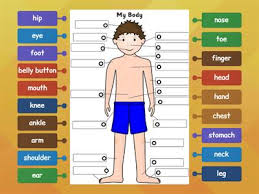
BODY PARTS
About Course
About Course
Welcome to “Body Parts & Everyday English: Exploring the Human Body”! This interactive online course is explicitly designed for A2–B1 (Beginner to Intermediate) level English learners who wish to develop the essential language skills needed to identify, describe, and talk about the human body in everyday situations. Through a series of task-based interactive activities, students will move from passive vocabulary recognition to active language production.
This course focuses on real-life communication, helping learners confidently use English when describing appearance, health, injuries, and physical conditions in a modern, practical context.
Course Aims
This course aims to equip pre-service teachers and language learners with practical vocabulary related to body parts, functional grammar structures, and communicative strategies needed for describing the human body and basic health-related situations. By integrating multimodal content, the course fosters learner autonomy, engagement, and communicative competence in open and distance learning (ODL) contexts.
Course Content
4 Lessons • 1 Quiz
Lesson 1:Introduction to the Human Body & External Anatomy
This lesson prepares students for Activity 1 (Drag the Words) by introducing core external body parts and their relative positions.
Learning Objectives
Identify and label major external body parts (limbs, joints, head, and torso).
Describe the physical location of body parts using basic prepositions of place.
Vocabulary Focus
Core Parts: Head, neck, chest, stomach, back, shoulder.
Limbs & Joints: Arm, elbow, wrist, hand, finger, leg, knee, ankle, foot (plural: feet), toe.
Grammar & Functional Language
Prepositions of Place: Above, below, between, next to, in the middle of.
Example: "The neck is between the head and the shoulders."
Example: "The elbow is in the middle of the arm."
Possessive Adjectives: My, your, his, her, their.
Example: "She fractured her wrist during tennis practice."
Real-Life Context: Describing Physical Appearance
"He is quite tall with broad shoulders."
"She has a small tattoo on her left wrist right next to her watch."
1 Lesson
Lesson 2: Inside the Body – Internal Organs & Vital Functions
Course Alignment: This lesson builds the foundational knowledge required for Activity 3 (True or False), focusing on what our organs do.
Learning Objectives
Name major internal organs and systems in English.
Explain the basic functions of these organs using clear, simplified language.
Vocabulary Focus
Internal Organs: Brain, heart, lungs, stomach, liver, kidneys.
Support Systems: Bones, skeleton, skin, muscles, tongue.
Grammar & Functional Language
Expressing Purpose (Use ... to + Verb):
Structure: Subject + use(s) + noun + to + base verb
Example: "We use our lungs to breathe fresh air."
Example: "The body uses the brain to think and process information."
Responsible for + -ing:
Example: "The heart is responsible for pumping blood."
1 Lesson
Lesson 3:Common Aches, Pains & Everyday Illnesses
Learning Objectives
Express physical discomfort, common illnesses, and daily health complaints.
Differentiate between the suffixes -ache, sore, and hurt.
Vocabulary Focus
The "-ache" Suffix: Headache, stomachache, toothache, backache, earache.
Other Symptoms: Sore throat, cough, cold, high temperature/fever, bleeding, swollen.
Grammar & Functional Language
Talking about Illness (Have / Have got):
Example: "I have a terrible headache today."
Example: "She has got a sore throat and cannot swallow."
Using "Hurt" as a Verb:
Structure: [Body Part] + hurt(s)
Example: "My eyes hurt because I stared at the screen for too long."
Real-Life Context: Calling in Sick
"Good morning, I can't come to work today because I have a fever and a severe stomachache."
1 Lesson
Lesson 4: Minor Injuries & Interacting with Healthcare Professionals
Course Alignment: This final unit prepares students for Activity 4 (Multiple Choice Dialogues) and the Final Exam by focusing on active communication.
Learning Objectives
Describe sudden minor injuries (cuts, burns, sprains, fractures).
Engage in a basic, functional dialogue with a doctor, pharmacist, or triage nurse.
Vocabulary Focus
Injuries: Cut, burn, sprain, twist, break/fracture.
Treatments: Painkiller, tissue, cast, bandage, lotion, ointment, rest.
Grammar & Functional Language
Past Simple for Incidents:
Example: "He fell off his bike and broke his leg."
Example: "I twisted my ankle while jogging yesterday."
Asking for and Giving Advice (Should / Need to):
Example: "What should I do for a burn?" -> "You should put cold water on it immediately."
Real-Life Context: At the Triage Desk
Nurse: "What seems to be the problem?"
Patient: "I tripped on the stairs and sprained my ankle. It is completely swollen and I can't walk on my foot."
1 Lesson
Final Quiz
End-of-course assessment designed to comprehensively measure all vocabulary, grammar structures, and communicative strategies learned throughout the course
1 Quiz
Student Ratings & Reviews

- Intermediate
- 6 Total Enrolled
- 2026-07-24 Last Updated
- Certificate of completion